
Net Zero Homes
MAKAR is committed to transforming Scotland's construction industry from one of the country's largest carbon emitters into a climate solution. The construction sector contributes approximately 38-40% of global carbon emissions, with the built environment in Scotland facing increasing pressure to decarbonise ahead of the nation's 2045 net zero target. MAKAR challenges the assumption that building development is inherently harmful to the environment by demonstrating that homes can actively sequester carbon whilst providing affordable, healthy living spaces.
Independent research from the University of East Anglia on four MAKAR terraced homes confirmed that MAKAR homes were carbon negative on delivery when carbon sequestration was taken into account.
MAKAR homes have 27% lower embodied carbon than standard timber frame houses and 39% lower than brick-built Passivhaus equivalents. The research indicated the relative up-front embodied carbon of a four person two bed home to be around 26 tonnes, and, amazingly, each progressive timber-derived home was able to lock up 39 metric tonnes of sequestrated carbon. With approximately one tonne of CO2 stored per cubic metre of timber, these homes actively remove carbon from the atmosphere.
The full picture of ongoing emissions and therefore running costs of the home is also startling; for this four-person two-bed home, costs spread over a year came to around £5 / week of non-fossil-derived energy input for comfort.
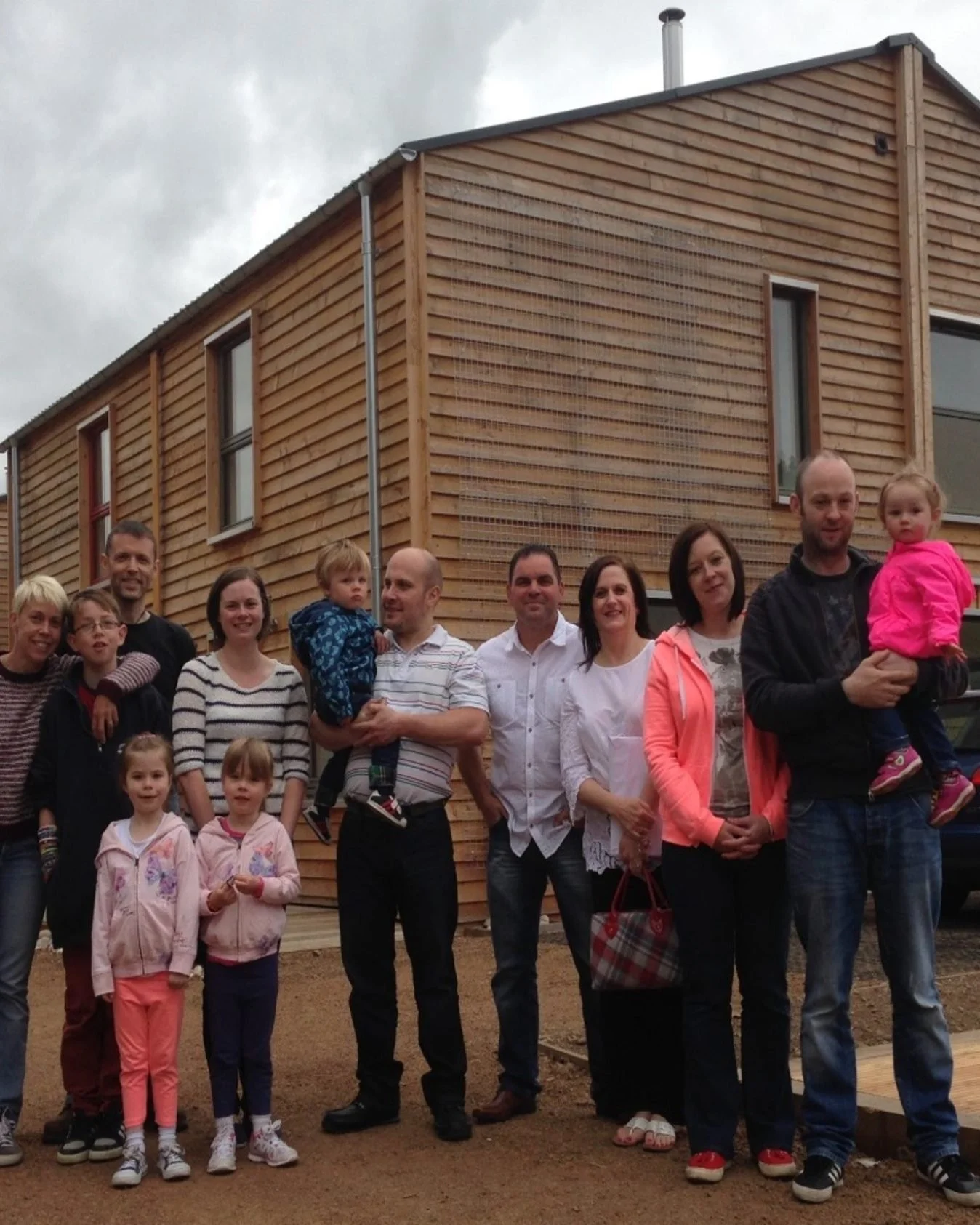
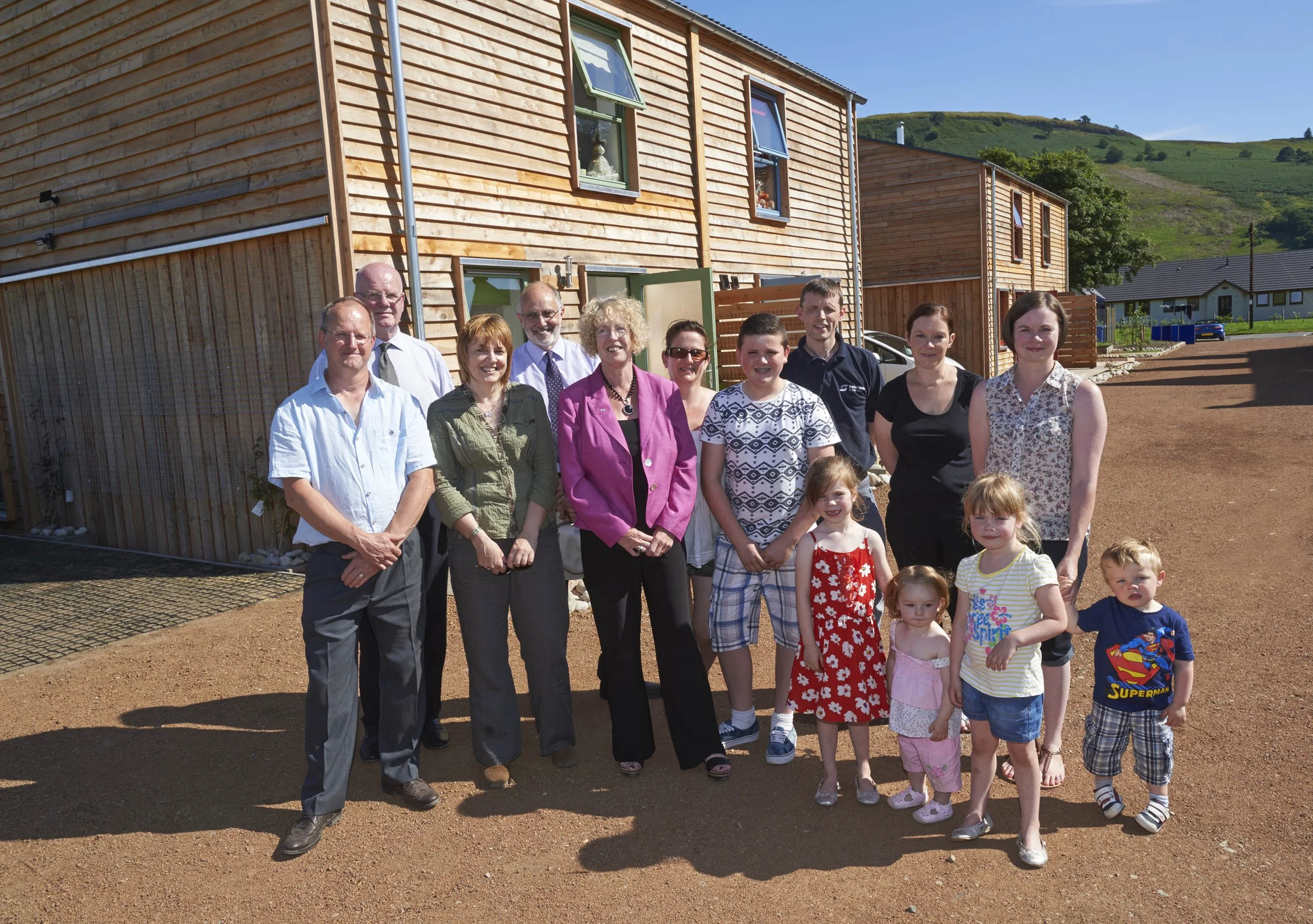
This picture was taken 10 years ago as four MAKAR homes commissioned by the now-renamed Communities Housing Trust were handed over to families. These were the houses included in the Carbon Measurement Study above
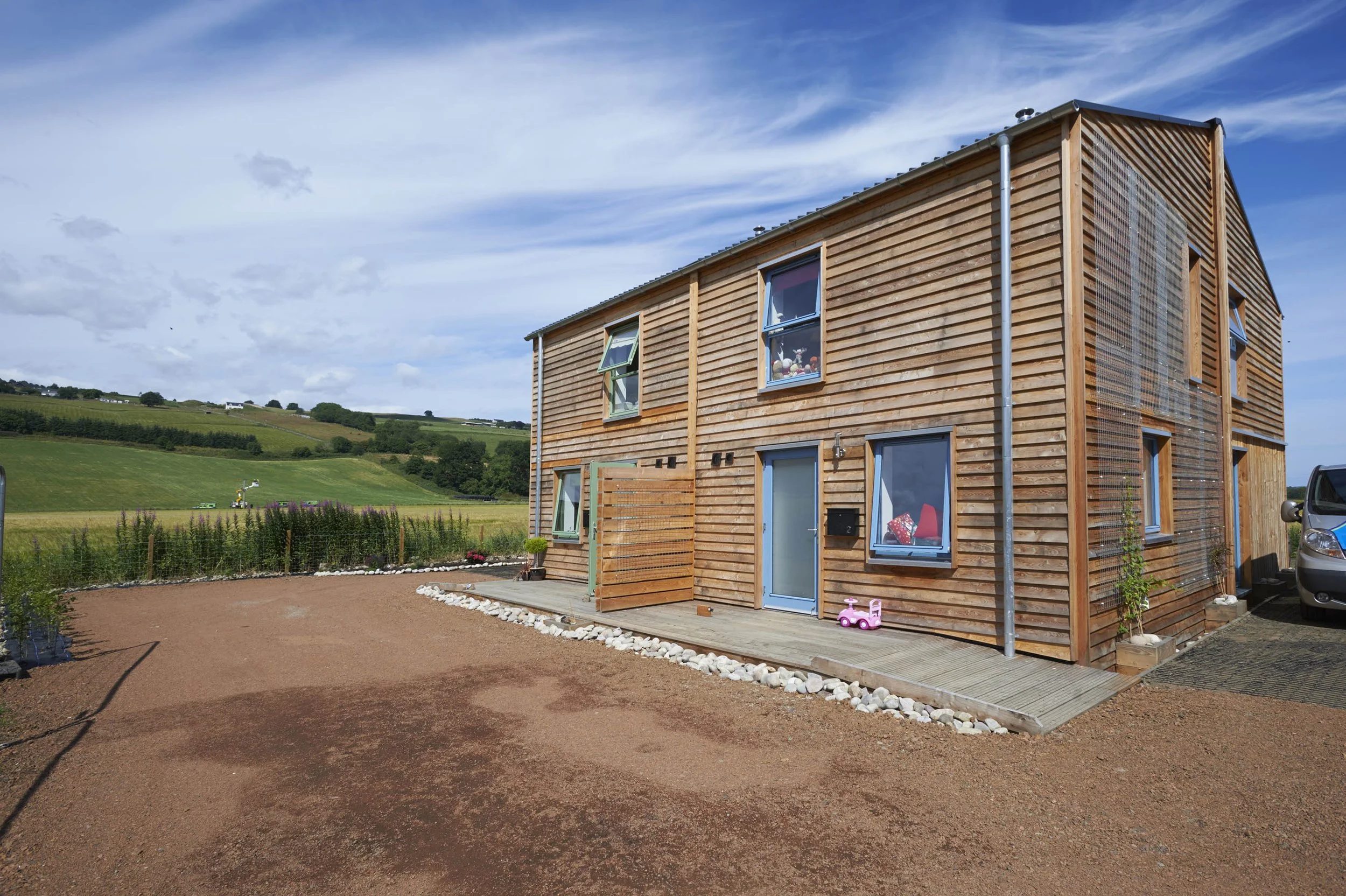
These modest semi-detached homes were predicated on minimising steel, concrete and plastic, all high energy and carbon intensive materials. In their place are timber and other renewable natural materials, many of which were sourced within 50 miles of the homes themselves.
When assembled, all of our homes have intrinsic comfort, health, and longevity. They are autonomously robust enough to function in life support mode in temperatures of 40 degrees plus, without grid electricity. They are as close to net-zero as it is possible to be at the present time by way of a Nature-based and Circular-aligned Solutions.
A Life Cycle Assessment of homes: Why measure both embodied and operational carbon content?
Every average new house completed in the UK contributes 35 to 50 metric tonnes of CO2 due to its ‘upfront’ emissions from the materials used and the industrial processes that result. Steel, concrete, and plastics are high-embodied-carbon materials with resulting high emission contributions. Due to the limited supply chain options in this country, an average run-of-the-mill volume built speculative house is full of these materials. Scotland differs from the other devolved nations, however, in its uptake of timber panel as a construction type. On the face of it, this is positive as the structure holding the building up is timber-derived instead of concrete block. Nonetheless, when compared with all the other materials utilised, from PVC windows to concrete roof tiles, the timber portion is disappointingly restricted.
The Life Cycle Assessment of our homes recognises the inherent combined embodied and operational carbon content, and until we see this whole picture, we are unlikely to address any realistic point of view fully.
We are asking a different question - how can we utilise the dire need for new homes across the country while making a tangible contribution to climate action?
We use low-carbon, non-toxic home-building materials
More than just replacing concrete and steel with Scottish timber, MAKAR are leading the way in eliminating toxic, synthetic and high-carbon materials in homes. Removing single-use oil-based components and a short-termist approach to home building have profound implications for both the environment and the health of occupants.
Here are just a few of the toxic components found in modern homes and what they can be replaced with in MAKAR homes:
Polyurethane Insulation —> Wood-fibre insulation
Chemical-treated timber —> Naturally durable timber
Plastic cladding —> Timber cladding (such as with Larch)
uPVC windows —> Laminated timber windows
Our process has evolved over 25 years, and we are now able to apply our approach to affordable and terraced housing, suitable for families on a lower budget, employers looking to house rural workers, and local authorities looking to provide better quality council homes, with low heating bills.
Watch our video from the launch of our Paradigm Home prototype.
Frequently Asked Questions
-
Research shows carbon storage is approximately 50% higher in timber framed homes than in masonry homes. MAKAR goes further still by using a timber-rich approach Scottish-sourced timber, cellulose insulation with no petrochemical content, and a circular economy design philosophy. (Source: https://www.theccc.org.uk/publication/wood-in-construction-in-the-uk-an-analysis-of-carbon-abatement-potential-biocomposites-centre/)
Why is this emportant? Here’s what the UK government has to say:
“The built environment accounts for 25% of the UK’s annual greenhouse gas emissions. By increasing the use of timber, which sequesters carbon, we can significantly reduce these emissions to achieve net-zero by 2050, while simultaneously growing our economy. This aligns with broader initiatives such as zero-waste economy, and decarbonisation of concrete, steel, and cement.” (Source: Scottish Government, 2025: https://www.gov.uk/government/publications/timber-in-construction-roadmap-2025/timber-in-construction-roadmap-2025)
-
Every average new house completed in the UK contributes 35 to 50 metric tonnes of CO2 due to its ‘upfront’ emissions from the materials used and the industrial processes that result. Steel, concrete, and plastics are high-embodied-carbon materials with resulting high emission contributions.
-
The Life Cycle Assessment of our homes recognises the inherent combined embodied and operational carbon content, and until we see this whole picture, we are unlikely to address any realistic point of view fully.
-
In MAKAR Homes we replace a number of high carbon materials with non-toxic natural and low carbon materials for healthier net zero homes. For example:
Polyurethan Insulation —> Wood-fibre insulation
Bituminous waterproofing —> Woven geotextiles
Chemical-treated timber —> Naturally durable timber
Plastic cladding —> Timber cladding (such as with Larch)
uPVC windows —> Laminated timber windows